
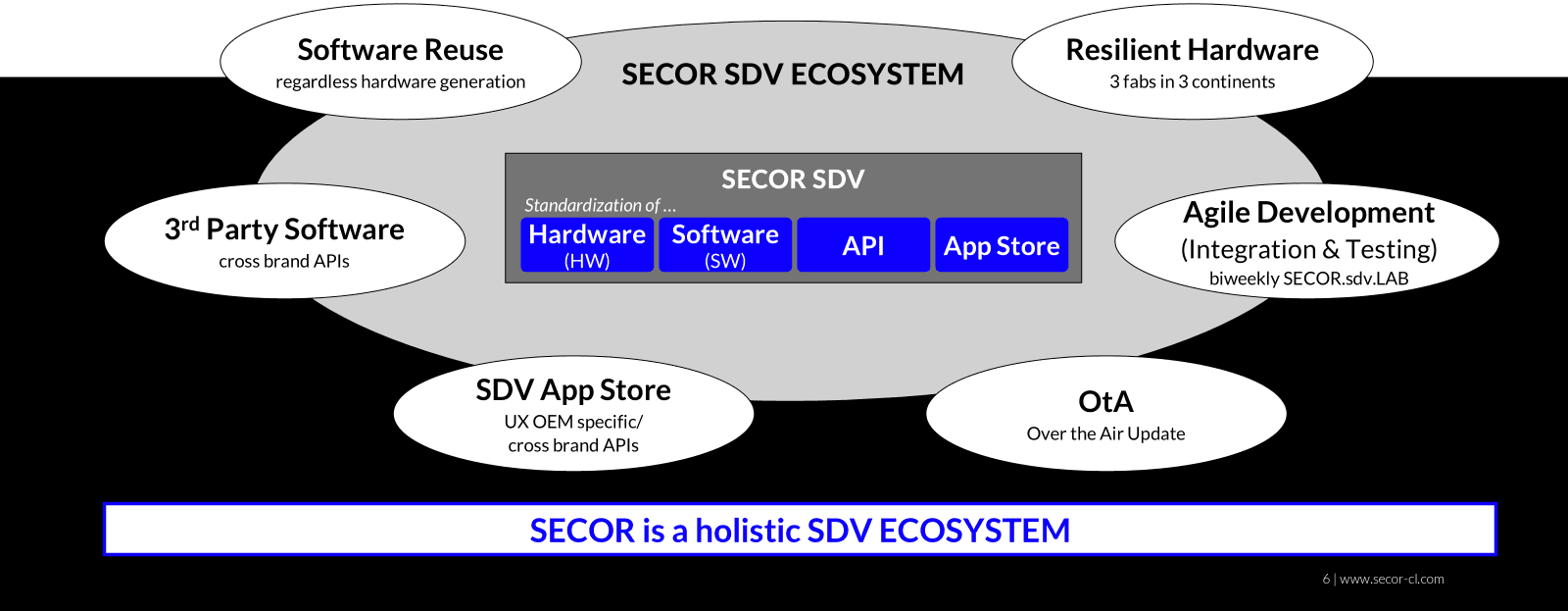
SECOR SDV ECOSYSTEM

The whole is greater than the sum of its parts.

The SECOR SDV ECOSYSTEM combines standardized hardware (HW), modular software (SW), open APIs, and a cross-brand app store into a holistic system. Built for OEMs and Tier 1 suppliers who want to not only accelerate the Software Defined Vehicle (SDV) but fundamentally redesign its architecture.

The Ecosystem Concept

A holistic approach from PC to SDV

SECOR does not focus solely on software optimization; instead, it takes a holistic approach that encompasses hardware, software, and data exchange within the SDV. The result is an ecosystem that standardizes all levels simultaneously: from functionally compatible MCU architecture (Microccontroller Unit) From software levels all the way up to cross-vehicle API standard interfaces. Everything is interconnected. Everything is coordinated.

The four pillars

Hardware (HW)

Chiplet MCU

RISC-V · multi-fab · functionally compatible with for decades

Software (SW)

3-tier architecture

modular · reusable ·
suitable for all ages

API

Interfaces

Vehicle-agnostic · Cross-brand · according to COVESA VSS open

App Store

B2B + B2C

OEM-specific · Cross-brand third-party suppliers

Image (1)
Software
Reuse

Regardless of hardware generation—once qualified, it can be used indefinitely

3rd Party
Software

Cross-brand APIs – Third-party developers build once, reach all brands

SDV
App Store

OEM-specific & cross-brand – B2B and B2C

OTA
Update

Over-the-Air Update – anytime, without a trip to the shop

Resilients
Hardware

3 fabs on 3 continents – no single-source risk

Agile
Development

Integration & Testing every 14 days via SECOR.sdv.LAB
“SECOR is currently the only provider that standardizes both hardware and software.”

VC investor following an analysis at CES 2025 in Las Vegas

The four building blocks

Four elements that only work to their full potential when combined.

Each component of the SECOR SDV ECOSYSTEM is powerful on its own – but its true strength lies in how they work together. Because hardware interfaces remain stable, software can be reused. Because APIs are standardized, apps can work across brands. Because everything is interconnected, a system emerges that gets better with every vehicle project.

Hardware (HW)

Durable. Interchangeable. Compatible for decades.

Chiplet-based RISC-V MCU family, developed in collaboration with among others the Fraunhofer IIS, stable hardware interfaces across generations—inspired by the PC (x86 processor), which has been connecting hardware and software compatibly for over 40 years. Interchangeable,produced simultaneously by different manufacturers at three manufacturing sites (Fabs) at three different continents for a resilient supply chain.

Software (SW)

Developed once. Used time and time again.

Modular software architecture in three layers: Hardware abstraction (Level 3), Functional logic (Level 2) and OEM branding (Level 1). Software is developed and validated once—and then used in as many vehicle generations as needed. Because the hardware interfaces remain stable, there is no need to up to three-quarters recompile of the vehicle software during a generation change of an MCU. Currently this the case approximately every seven years for a model.

API

Standardized interfaces. Open to everyone.

All software layers are connected via standardized APIs based on the COVESA Vehicle Signal Specification (an open data model for standardizing vehicle data). Cross-vehicle and cross-brand interoperability—without affecting OEM-specific brand and customer interfaces. The functional logic, typically developed by Tier 1 suppliers, is freely tradable.

SDV App Store
A marketplace for the entire SDV community.

Functional logic modules can be sold in the B2B SDV App Store—including to new customers and markets. End customers buy or exchange apps via a brand-specific B2C App Store. OEMs can set up subscription services. Third-party providers develop once and reach all brands, including user experience specific front ends. The customers segment is becoming attractive to third parties: Smartphone effect on behalf of the SDV.

How the ecosystem works

What changes when everything at has been part of the whole from the very beginning.

The SECOR SDV ECOSYSTEM doesn’t change individual steps in the development process – it changes the logic of the entire process. Hardware and software run in parallel because they are built on the same foundation. Integration becomes routine because the interfaces are standardized. Software evolves alongside the vehicle because the architecture allows for it.

Parallel development

Hardware and software. Together from day one.

Because all Tier 1 partners use the same hardware platform, hardware and software development run in parallel from the very start – coordinated by SECOR.sdv.LAB with integration tests every 14 days. This means that defects are identified early on, rather than later when they become costly.

Software Reuse

Qualify once. Use it across generations.

Stable hardware interfaces mean that software does not need to be recompiled (approx. three-quarters reprogrammed) or qualified. Modules from earlier vehicle projects can be reused directly – maintaining the quality level of the previous generation.

Vehicle as a platform

OTA updates. Services. New business models.
Software extends beyond the individual vehicle. OTA updates deliver new features to vehicles at any time. Data-driven services, subscription models, and third-party apps are only made economically viable through standardized APIs.

SECOR SW Architecture in three levels:

Level 1

User Interface & OEM Branding

OEM-specific user experience (UX) and brand identity – remain entirely under the OEM’s control

Level 2

Functional logic

Whether from a Tier 1 supplier, OEM, third-party provider, or open source (e.g., Eclipse SDV) – available for purchase in the SECOR.app.STORE

Level 3

Hardware Abstraction

Standardized hardware abstraction layer – completely decouples software from the physical hardware

All levels are connected via standardized APIs based on the COVESA VSS data model – across all vehicle makes and models.

Plug & Play: The Next Level

The vehicle configures itself.

In the next phase of development for the SECOR SDV ECOSYSTEM (patent pending), every component will be plug-and-play compatible. As soon as it connects to the vehicle network, it automatically receives a local IP address – similar to devices on the Internet. The necessary software is automatically downloaded from the SECOR.app.STORE.

Thumbnail Secor 01c

Dual-use

1st Classic Car
21st century
Functionally Compatible Hardware

Modern Classic
: Replacement for defective
Motor Controller

Data Usage, OTA (Over-the-Air) Updates, and Predictive Maintenance

Ethernet network-
Standardized-
Wiring harness sections

Plug & Play
, prototype assembly
, Discovery Mode

Development

First technology demonstrator / prototype without new development

Components can be combined flexibly. The configuration is generated automatically from the directory service – no manual setup, no recompilation. (Similar to a PC: the appropriate printer driver is downloaded when the printer is connected for the first time.)

Production & After-Sales

Replace components without having to redesign them

The SECOR DIRECTORY SERVICE Identifies installed components and compatible software alternatives – even if the hardware is not identical. Parameter settings and software updates are installed over-the-air (OTA).

Data & Services

Vehicle data as a platform

All vehicle data is routed through a central API. Logging, cloud transmission, AI analysis, Predictive maintenance – all based on the same standardized data set.

R&D Roadmap

The ecosystem is growing. Set the course now.

SECOR is already presenting the SDV PoC 2.0—a complete, fully functional ECOSYSTEM. What comes next is already in development. The roadmap shows that this is the beginning of a platform, not the end of a project.

Today
2026

SECOR SDV PoC 2.0 – Automotive Electronics Congress (June 16–17, 2026)

The complete ecosystem – live and fully operational

Hardware, Software & API (in development: App Store, OTA, and Plug & Play) – fully integrated and ready for its first live demonstration. The foundation for all further stages of development.

June 11, 2026 Samurai Sticker (Transparent)

IAA
2027:

BAVARIAplus SDV 1.0 (FPGA-based) – Ready for the market for small-scale production

SDV compatible with classic cars—developed in collaboration with a technology partner

FPGA-based central.CU and zonal.CU for small-scale production (Collectors Cars). SECOR is already actively developing vehicles in collaboration with a handful of partner companies. Vehicles that the first classic car of the modern erasince the hardware has been upgradeable for over 30 years and is therefore the Software never becomes obsolete.

Auto Landing Page Gray

IAA
2029:

BAVARIAplus SDV 2.0 (silicon-based) – Ready for mass production

Ready for OEM mass production

Silicon-based central.CU and zonal.CU, designed to meet the requirements of large-scale production . Vehicle product development without changing systems, from the engineering prototype to mass production.

Car Landing Page Blue 1500x4021px

Further potential – in development

The First Classic Car of the 21st Century

Functionally compatible hardware enables SDV, with SECOR.inside, to perform a future overhaul of the E/E architecture—even if the original replacement parts are no longer available through after-sales channels. Simply install the future, i.e., the then-current central.CU or zonal.CU.

It will work because it is functionally compatible.

Youngtimer Engine Control Unit

Upgrading the electric motor control systems of the iconic cars of the 1980s (e.g., BMW M3 (E30), Mercedes 190 2.3 16, the original Audi Quattro, etc.) is now possible with SECOR zonal.CU and original software – FPGA.

Initial proof-of-concept projects are in the planning stages, and discussions with technology partners (OEMs and Tier 1 suppliers) are underway.


100% Ethernet Cable Assembly

Standardized wiring harness sections for zonal architecture – significantly fewer variants, reduced weight, optimized final assembly at the OEM, and lower overall costs.

We are currently collaborating with Tier 1.

Dual-use

SECOR enables hardware replacement without a software update. This is of interest wherever industries install ECUs and face either rapid development cycles (drones) or long after-sales periods (agricultural machinery, capital goods, etc.).

The SECOR SDV ECOSYSTEM is not limited to the automotive industry.

Become a Partner

Join us.
Help shape the standard.

SECOR is building the SDV ECOSYSTEM in collaboration with technology partners – OEMs, Tier 1 suppliers, and development service providers – who not only want to use the new standard but also help shape it. Bring your ECU-equipped components or a concept vehicle. The next phase begins now.

OEMs

New I/O Architecture – Get Started Now

Do you have an unused hardware platform? A prototype that’s destined for the scrap heap? Working with our technology partners, we can integrate the SECOR SDV ECOSYSTEM into these platforms, ensuring security. Thanks to a corporate venture capital investment in SECOR, there are no costs to your development budget.

Together, we set the standard – and lay the groundwork for the next generation of vehicles.

Tier 1 suppliers

Contribute components, help shape the ecosystem

SECOR is the only provider to standardize both hardware and software simultaneously – a patented ECOSYSTEM with a clear first-mover advantage. Contact us to discuss partnership opportunities for any component.

For example, discussions are currently underway regarding zonal.CU, central.CU, ECU components, wiring harnesses, …

Software provider

Develop it once. Available everywhere.

Develop functional logic modules for the SECOR.app.STORE—brand- and vehicle-agnostic, and distributable to all partners in the ecosystem.

Using the standard API interfaces, third-party software developers can offer SECOR.inside to all OEMs with different user experiences. A smartphone-like experience for the SDV.